Challenges of ASEAN and the Member States in Values and Spirit
Thurain Win
Abstract
This paper expores ASEAN’s challenge in maintaining centrality and consensus amidst complex geopolitical and developmental issues between member states. ASEAN’s “Centrality” doctrine puts ASEAN at the forefront of regional security and diplomacy, with ASEAN-led mechanisms like the East Asia Summit and Regional Forum facilitating dialogue among major powers. But the consensus-based decision-making process typically leads to inefficiencies and inaction, particularly on the South China Sea dispute and Myanmar’s political crisis. While consensus fosters cohesion, it has been blamed for leading to “lowest common denominator” outcomes and an inability to act with firmness, which leads to “collective muteness.” ASEAN is also faced with enormous development gaps between old members (ASEAN-6) and newer members (CLMV countries; Cambodia, Laos, Myanmar, and Vietnam), which complicates the realization of a shared agenda. CLMV nations’ growing economic reliance on China through initiatives like the Belt and Road Initiative limits ASEAN’s strategic autonomy. The region being situated in a U.S.-China competitive landscape pushes ASEAN members to “hedge” between the two, challenging organizational unity. Reforms proposed are reducing the development gap between members, reforming consensus for timely decisions, and expanding interactions with external powers to entrench centrality. These reforms hold the key to ASEAN’s continued relevance and leadership, particularly to Vision 2045. The paper argues that ASEAN’s existence depends on adapting to pressures while maintaining its principles of cooperation, peace, and stability.
Keywords: ASEAN, China, CLMV, Myanmar, member states, ASEAN spirit.
1. The ASEAN Foundational Mandate: Centrality And The ASEAN Way
1.1 Defining ASEAN Centrality: the Strategic Imperative
ASEAN Centrality (AC) is the organizing principle upon which the regional security architecture is constructed and is formally articulated in foundational documents, including the ASEAN Charter and the Treaty of Amity and Cooperation in Southeast Asia (TAC). Defined as a mechanism to ensure ASEAN maintains its authority and influence, AC aims to establish the organization’s leadership role in shaping regional affairs and is necessary to strengthen ASEAN unity and cohesiveness. The TAC’s mandate is to establish a code of conduct for interstate relations, promoting peace, stability, and cooperation.
Centrality operates primarily through ASEAN-led mechanisms, such as the East Asia Summit (EAS), the ASEAN Regional Forum (ARF), and the ASEAN Defense Ministers Meeting (ADMM)-Plus. These forums are designed to be inclusive, providing institutional architecture where regional and global major powers including the United States, China, and Japan engage in multilateral and bilateral dialogues. Despite this mandate, ASEAN struggles to maintain relevance when faced with “intractable problems,” such as the ongoing political crisis in Myanmar and China’s assertive posture in the South China Sea (SCS).
The primary purpose of the TAC, signed in 1976, is to promote perpetual peace, everlasting amity, and cooperation among the peoples of Southeast Asia. It serves as ASEAN’s first legally binding treaty and its organizational keystone. The core of the TAC’s mandate is contained in its Fundamental Principles (Article 2), which serve as the legal and normative basis for the way ASEAN operates:
- Mutual respect for the independence, sovereignty, equality, territorial integrity, and national identity of all nations.
- The right of every State to lead its national existence free from external interference.
- Non-interference in the internal affairs of one another.
- Settlement of differences or disputes by peaceful means.
- Renunciation of the threat or use of force.
- Effective cooperation among themselves.
The ‘ASEAN Spirit’ is codified by the principle of non-interference and unanimous agreement, known as the ‘ASEAN Consensus’ (ACo), which represents the region’s historical ‘legacy’. Proponents argue that consensus is vital to secure the capacity of ASEAN to “speak with one voice” in the concert of nations.4 ASEAN Centrality is often more symbolic functioning as a key agenda-setter or convener than it is decisive or action-oriented. The consensus principle, while providing essential inclusivity that protects the diverse group’s unity, simultaneously paralyzes timely and effective collective action on contentious political-security matters.
However, the singular pursuit of harmony inherent in ACo has resulted in operational shortcomings, revealing an enduring paradox:
- Lowest Common Denominator: Critics charge that consensus diplomacy often requires adopting the least ambitious policy position acceptable to all member states.
- Collective Muteness: The most serious charge is that consensus can result in a “collective muteness,” rendering ASEAN silent or incapable of decisive action when confronted with major political or humanitarian crises.
This reveals that while ACo prioritizes intra-regional harmony (preventing internal schism), at the cost of external decisiveness and credibility. This systemic vulnerability has become the primary mechanism through which external powers can challenge ASEAN’s effectiveness.
2. The Internal Fault Line: Development Gaps And Structural Vulnerability
- South China Sea Split: where non-claimant states like Laos and Cambodia, often economically aligned with China, resist strong anti-Beijing statements, weakening the collective negotiating position of claimant states.
- Development Gap: Wide disparities in economic and political development (between original and newer members) create differing national priorities, making it difficult to forge a cohesive political or economic agenda.
The critical axis of internal discord runs along the developmental fault line separating the original members (Brunei, Indonesia, Malaysia, Philippines, Singapore, and Thailand often referred to as ASEAN-6) and the CLMV states: Cambodia, Laos, Myanmar, and Vietnam. The CLMV states, having joined later, possess significant economic and infrastructural disparities compared to the ASEAN-6. This developmental gap gives rise to the perception of ASEAN as a “two-tier organization”.
The ‘People-Centered Approach’ and the ‘Connectivity’ agenda, vital for realizing the ‘ASEAN Community Vision 2045,’ demand that ASEAN bridge this gap to reduce economic inequality and effectively integrate all members across the political, economic, and socio-cultural pillars.7 The pursuit of rapid economic integration, vital for the CLMV bloc, opens these states to intensive engagement with external partners.
3. Geopolitical Tensions: The Operational Strain On Consensus
The strategic environment is characterized by great power competition, which presents both opportunities and severe challenges to ASEAN’s Centrality. ASEAN’s strategic response is often characterized as hedging—a mechanism whereby the organization preserves its institutional relevance by making itself the necessary platform for engagement among competing interests, such as managing the Belt and Road Initiative (BRI) or the Indo-Pacific Economic Framework (IPEF).
- Pressure to Choose: The escalating strategic competition forces individual ASEAN members to ‘hedge’ between the two powers, risking being pulled into opposing spheres of influence and undermining the group’s collective strategic autonomy.
- Competing Frameworks: The competition manifests through rival economic and security initiatives (e.g., China’s Belt and Road Initiative vs. the US Indo-Pacific Economic Framework), which offer selective benefits that can entice individual members to bypass ASEAN-led mechanisms.
- Rise of Minilateralism: The formation of exclusive, small groupings like the Quadrilateral Security Dialogue (QUAD) consisting the US, Japan, India, Australia, and the Trilateral Security Partnership between Australia, the United Kingdom, and the United States (AUKUS) (Australia, UK, US) reflects a growing perception among major powers that ASEAN-led forums are too slow or ineffective for addressing urgent security challenges, thus bypassing the principle of ASEAN Centrality.
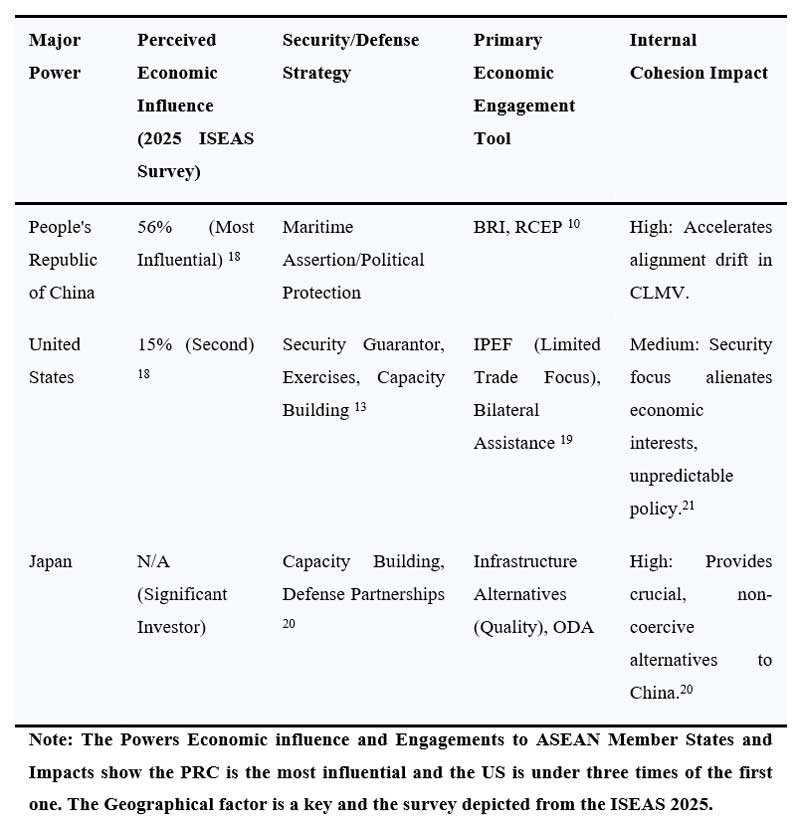
ASEAN’s traditional decision-making processes, collectively known as the ‘ASEAN Way,’ are increasingly inadequate for addressing modern crises. The following matrix compares the major power engagement dynamics:
Table 1. Geopolitical Influence Matrix: Comparing Major Power Engagement Strategies
4. Policy Recommendations For Sustaining Centrality And Consensus (Toward Vision 2045)
To navigate the current geopolitical polarization and secure ASEAN’s relevance toward the Community Vision 2045, the organization must adopt actionable, structural policy reforms.
The core mechanism of structural vulnerability should be addressed by eliminating the economic gap that makes CLMV states susceptible to external political coercion.
- ASEAN Internal Resilience Fund: ASEAN should to establish a substantially enhanced, organization-managed infrastructure and capacity-building fund. This mechanism should pool significant resources from the ASEAN-6 and committed Dialogue Partners (Japan, South Korea, EU). The explicit goal must be to finance CLMV connectivity and industrial development to reduce their exclusive reliance on China-led engineering and BRI financing.
- Deepening AEC Integration: The ASEAN Economic Community agenda must accelerate programs specifically tailored to reduce trade barriers, streamline logistics, and enhance governance reform within the CLMV bloc. The successful completion and implementation of RCEP, strategically linked to the AEC Blueprint 2025, is non-negotiable for demonstrating ASEAN’s long-term economic viability and centrality.
The principle of Consensus must be procedurally reformed to address the persistent problem of ‘collective muteness’ without abandoning the sovereignty-protecting mandate of the ASEAN Way.
- Implement Consensus Minus X for Security: For highly contentious, non-existential security issues such as maritime disputes, ASEAN should adopt a “Consensus Minus X” model for issuing joint communiqués and statements. This procedural refinement would permit the majority consensus (and particularly claimant states) to issue a binding statement, while formally allowing states unable to agree (the ‘X’) to note their non-participation without paralyzing the entire organization. This directly prevents recurrence of the 2012 scenario and addresses the ‘collective muteness’ critique.
- Strengthening the Chair’s Neutrality: To prevent the Chairmanship from serving as a veto proxy for an external patron, consultation procedures for the rotating Chair on politically sensitive issues must be formalized. This could involve introducing a standing troika mechanism or enhanced ministerial oversight to ensure the Chair operates strictly within the framework of collective ASEAN interest.
ASEAN must leverage its centrality to compel external powers to engage constructively.
- Conditioning Dialogue Partner Initiatives: ASEAN need to insist that all major Dialogue Partner initiatives, whether the US Indo-Pacific Economic Framework (IPEF), China’s BRI, or Japan’s Free and Open Indo-Pacific (FOIP) strategy, explicitly align with and report demonstrable progress against ASEAN’s three development blueprints (AEC, APSC, ASCC) and institutional goals.
- US Policy Recalibration: The United States need to overhaul its economic engagement, transitioning the IPEF into a genuine stepping stone for a comprehensive 21st-century trade agreement with Southeast Asia. Crucially, the U.S. must provide greater, sustained multi-year fiscal support for assistance programs and must urgently reconsider trade policies, such as the punitive tariffs that inadvertently punish vulnerable CLMV partners, thereby reinforcing the alignment drift toward China. The US must balance its necessary defense focus with robust economic offerings.
4. Policy Recommendations For Sustaining Centrality And Consensus (Toward Vision 2045)
The analysis demonstrates that ASEAN Centrality and the foundational Consensus principle are not failing due to a lack of formal mandate or institutional ambition, but rather due to a structural, economic asymmetry that has been successfully exploited by external great powers. The developmental reliance of the CLMV bloc on the PRC provides Beijing with a diplomatic veto proxy, transforming the Consensus mechanism from a guarantor of unity into a vehicle for institutional paralysis on critical security issues.
Sustaining ASEAN’s regional leadership role toward Vision 2045 demands an immediate, aggressive focus on internal cohesion. This includes closing the CLMV economic gap and strategically reforming the diplomatic procedures of the ASEAN Way to prevent the institutionalization of ‘collective muteness’. Simultaneously, ASEAN must manage external power engagement by compelling partners to align their strategies (economic and security) in a manner that truly reinforces, rather than exploits, the organization’s foundational principles. Only through these critical structural reforms can ASEAN secure the unity and credibility necessary to navigate a bipolarizing world and preserve its claim to Centrality.
As per BVI Journal’s standard guidelines and format, the authors following information are suggested to provide:
Data Availability Statement: Open sources
References
A job well done: Cambodia as ASEAN chair in 2012. (2013, January 19). East Asia Forum. https://eastasiaforum.org/2013/01/19/a-job-well-done-cambodia-as-asean-chair-in-2012/
ASEAN centrality and its narratives in an evolving regional order. (2025, March 26). E-International Relations. https://www.e-ir.info/2025/03/26/asean-centrality-and-its-narratives-in-an-evolving-regional-order/
ASEAN fails to reach consensus. (2012, July 13). TODAY. https://cil.nus.edu.sg/wp-content/ uploads/2010/01/13Jul2012_TODAY-ASEAN-fails-to-reach-consensus.pdf
Association of Southeast Asian Nations. (2021, August). Collective leadership, ASEAN centrality, and strengthening the ASEAN institutional ecosystem. https:// asean.org/wp-content/uploads/2021/08/ASEAN-Vision-2040-Volume-II_Collective-Leadership-ASEAN-Centrality-and-Strengthening-the-ASEAN-Institutional-Ecosystem.pdf
Asian Development Bank. (n.d.). Narrowing the development divide in ASEAN: The role of policy. https://www.adb.org/sites/default/files/publication/30403/reiwp-100.pdf
Economic Research Institute for ASEAN and East Asia. (n.d.). ASEAN consensus: The intangible heritage of Southeast Asian cooperation. https://www.eria.org/ ASEAN_at_50_4A_6_Villanueva_final.pdf
Institute of Developing Economies. (n.d.). China’s foreign economic cooperation for CLMV: Contact engineering in CLMV. https://www.ide.go.jp/library/English/Publish/ Reports/Brc/pdf/03_chapter3.pdf
Integration of the CLMV countries with the Association of Southeast Asian Nations. (n.d.). ResearchGate. https://www.researchgate.net/publication/327111690_Integration_of_the_CLMV_Countries_with_the_Association_of_Southeast_Asian_Nations
Ministry of Foreign Affairs of the People’s Republic of China. (2024, May 31). Joint statement of the foreign ministers of ASEAN member states and China on the full and effective implementation of the Declaration on the Conduct of Parties in the South China Sea. https://www.mfa.gov.cn/eng/zy/gb/202405/t20240531_ 11367337. html
National Bureau of Asian Research. (n.d.). U.S.-China economic rivalry in Southeast Asia and its implications. https://www.nbr.org/publication/u-s-china-economic-rivalry-in-southeast-asia-and-its-implications/
Wilson Center. (2022, October). Recalibrating U.S.-Japan Indo-Pacific strategies towards ASEAN. https://www.wilsoncenter.org/sites/default/files/media/uploads/ docume -nts/2022-10_Recalibrating-ASEAN_Koga.pdf
Wilson Center. (n.d.). Southeast Asia and U.S.-China competition: Contours, realities, and implications for the Indo-Pacific. https://www.wilsoncenter.org/ article/ southeast-asia-and-us-china-competition-contours-realities-and-implications-indo-pacific

Address
E-304, Mya Kyi Ryar 2nd Street, Htan Ta Pin Special Block, Dekkina Thiri Township, Naypyitaw.
Phone
(+959) 945 404 777
(+959) 882 640 707